Introduction
The truth is, deciding to integrate a telehealth platform with pharmacy systems is relatively easy. Building an integration that still works when prescription volume doubles, new states are added, and pharmacy partners change is where things become interesting.
That’s exactly why pharmacy integration for telehealth needs to be considered as part of the underlying operational infrastructure—not simply as a technical connection.
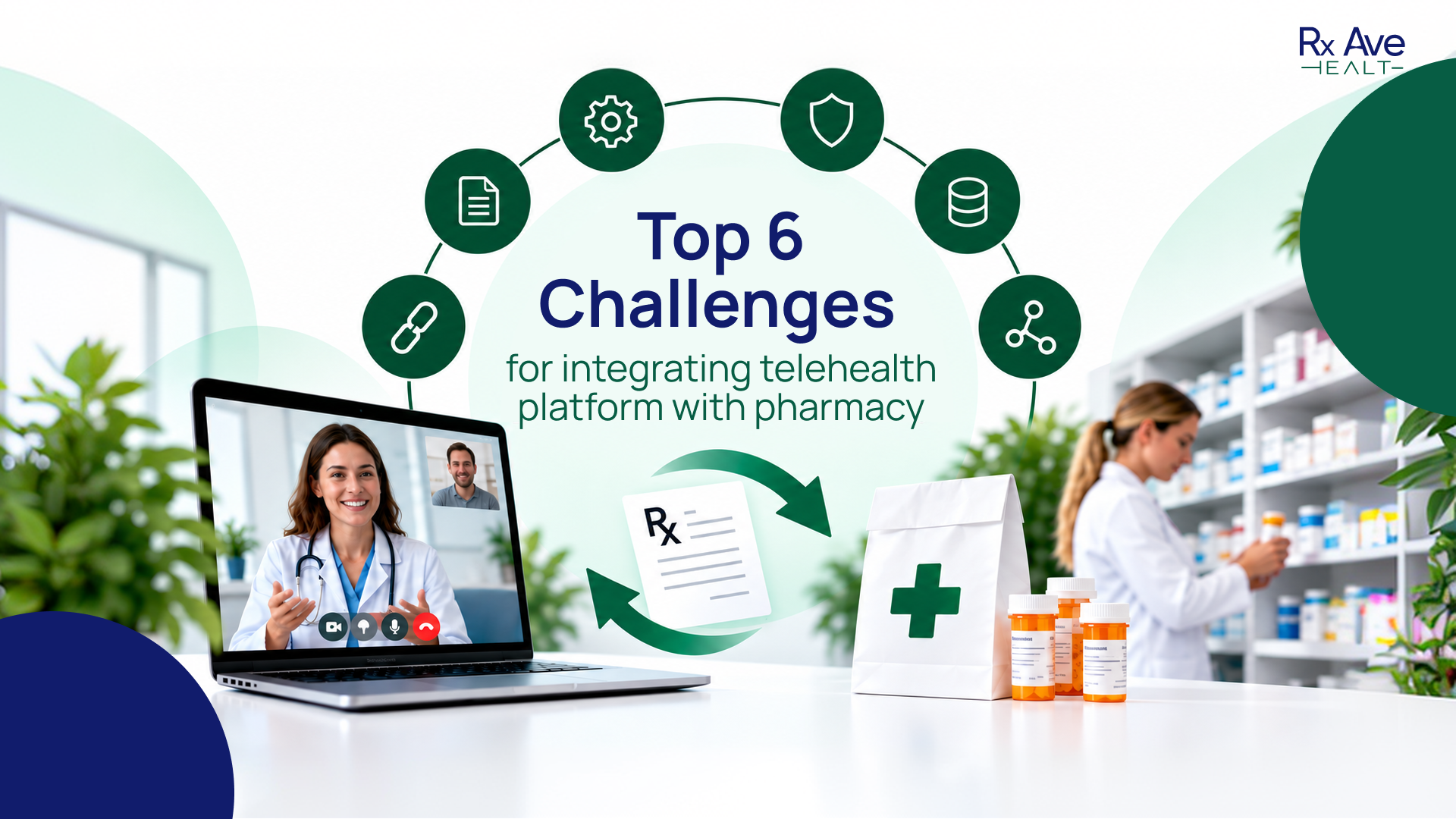
1. Every Pharmacy Has Its Own Way of Working
This is why many fast-growing companies are moving toward a connected multi-pharmacy network instead of relying on one-off integrations.
The goal isn’t simply adding more pharmacies.
It’s making pharmacy partners work together through a consistent operational ecosystem.
2. Your Platform Probably Isn’t the Problem
This is one reason pharmacy systems with telehealth integration require more than basic API connectivity.
They need an integration layer that can translate between different systems, standardize workflows, and keep data moving without constant human intervention.
3. Visibility Disappears the Moment a Prescription Leaves Your Platform
A mature telehealth pharmacy integration doesn’t just move prescriptions.
It makes every stage of the prescription lifecycle visible to the people who need it.
That’s a much bigger operational advantage than many founders realize.
4. Manual Work Doesn’t Stay Small for Long
The companies preparing for long-term growth aren’t waiting until manual work becomes overwhelming.
They’re investing in automation integration telehealth pharmacy services early, connecting workflow automation, provider workflows, and backend processes before operational debt starts piling up.
Platforms like RxAve are built around this idea, helping telehealth companies automate prescription routing, refill management, and pharmacy coordination instead of relying on people to fill the gaps.
5. Scaling Across States Makes Everything More Complicated
For growing companies, telehealth prescription fulfillment becomes increasingly important as prescription volume, pharmacy relationships, and geographic coverage expand.
Scalable infrastructure isn’t about preparing only for today.
It’s about avoiding operational chaos six months from now.
6. Integration Isn’t a Project. It’s an Ongoing Process.
The strongest telehealth businesses don’t think about telehealth pharmacy integration as something engineering completed last quarter.
They treat it as a living operational capability that supports every prescription, every refill, and every patient interaction.
Most telehealth founders think the hard part is launching.
Finding providers. Building the platform. Getting those first few hundred patients.
Then prescriptions start flowing.
That’s when the real work begins.
A refill gets delayed because one pharmacy handles requests differently than another. Support can’t tell a patient where their medication is. Providers are waiting for updates. Operations are chasing answers across emails, dashboards, and phone calls.
Nobody planned for that part.
The truth is, deciding to integrate a telehealth platform with pharmacy systems is relatively easy. Building an integration that still works when prescription volume doubles, new states are added, and pharmacy partners change is where things become interesting.
And that’s exactly where many growing telehealth businesses hit a wall.
Telehealth Has Matured. Operational Expectations Have Too.
Patients expect prescriptions to move as smoothly as their online shopping orders.
Providers expect visibility without calling pharmacies.
Founders expect growth without doubling their operations team.
Meeting all three expectations isn’t easy.
According to Grand View Research, the global telehealth market is expected to reach $455.3 billion by 2030, with continued adoption across healthcare delivery.
At the same time, the Office of the National Coordinator for Health Information Technology (ONC) reports that nearly all U.S. hospitals now use certified electronic health records. Yet interoperability between healthcare systems remains one of the industry’s biggest operational hurdles.
Healthcare has become more digital.
Operations, in many cases, haven’t.
That’s why pharmacy integration for telehealth is no longer just another feature on a product roadmap. It’s becoming the infrastructure that determines whether a platform can actually scale.
What Founders Expect vs. What Actually Happens
| What You Expect | What Actually Happens |
| One pharmacy partner is enough | Growth usually requires a flexible multi-pharmacy network |
| APIs solve integration | Different pharmacy systems still require orchestration |
| More patients simply mean more revenue | More patients expose operational bottlenecks |
| Support handles patient questions | Support becomes the bridge between disconnected systems |
| Expansion is mostly about licensing | Expansion is often an infrastructure challenge |
| Integration is finished after launch | It evolves alongside your business |
The Best Pharmacy Operations Are Almost Invisible
Think about the best online shopping experience you’ve had.
You probably don’t remember it.
Because nothing went wrong.
That’s exactly what good pharmacy infrastructure should feel like.
Patients aren’t impressed by sophisticated routing logic.
Providers don’t care how many APIs you’ve connected.
They simply expect prescriptions to arrive, refills to happen on time, and updates to be accurate.
When that happens consistently, nobody notices the infrastructure.
When it doesn’t, everyone does.
As telehealth businesses continue to grow, operational excellence is becoming just as important as patient acquisition. RxAve helps organizations streamline pharmacy coordination, prescription routing, workflow automation, backend operations, EMR integrations, and nationwide fulfillment through one connected infrastructure platform, helping operators scale without adding unnecessary operational complexity.
For a deeper look at how growing telehealth brands can improve their fulfillment operations, see our guide to prescription fulfillment for telehealth brands.
The Best Pharmacy Operations Are Almost Invisible
As telehealth businesses continue to grow, operational excellence is becoming just as important as patient acquisition. RxAve helps organizations streamline pharmacy coordination, prescription routing, workflow automation, backend operations, EMR integrations, and nationwide prescription fulfillment through one connected infrastructure platform.
FAQs
Are real-time prescription updates difficult to implement?
They can be. Different pharmacies exchange data differently, so real-time visibility usually takes more than a simple API connection.
Can integration delays affect patient experience?
Absolutely. Even small delays create uncertainty, and patients often judge the platform by how smoothly their prescription moves.
Why is pharmacy integration important for telehealth platforms?
Because writing the prescription is only the beginning. The real challenge is coordinating everything that happens after it leaves the provider.
Can outdated pharmacy systems slow down telehealth integration?
Yes. Legacy systems often need additional integration layers, making workflows slower and more dependent on manual intervention.
What technical issues commonly appear during telehealth pharmacy integration?
Disconnected APIs, inconsistent data formats, limited status visibility, and legacy workflows are some of the most common challenges growing telehealth platforms face.