Table of Contents
The GLP-1 market has created significant opportunities for telehealth businesses. Patients want convenient access to weight management care, providers are expanding virtual treatment programs, and pharmacies are building fulfillment networks to support growing demand.
But the market is also facing increased regulatory scrutiny.
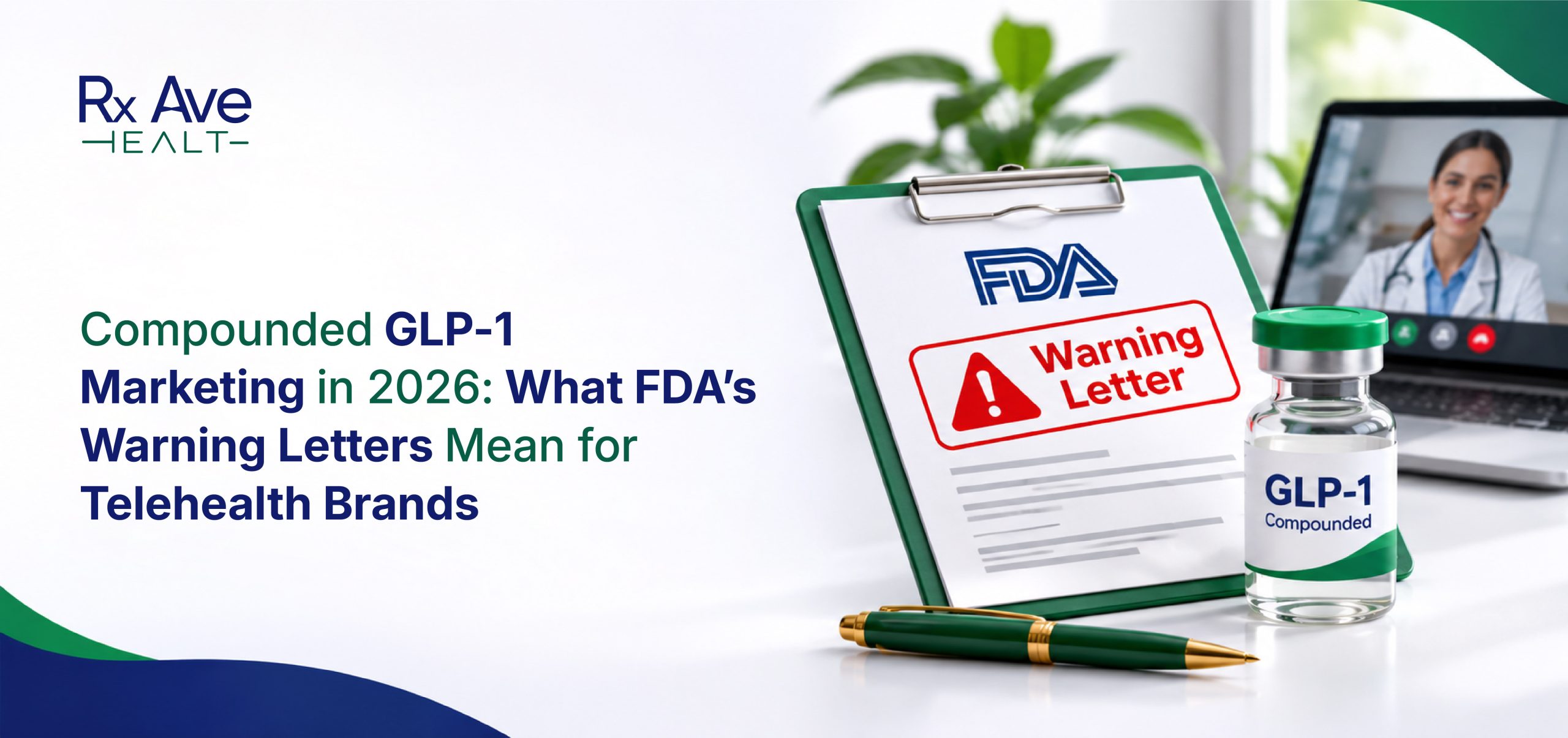
The FDA has raised concerns about how compounded GLP-1 medications are marketed, represented, and prescribed. Warning letters targeting companies promoting compounded medications highlight an important issue: offering a prescription service online does not remove the responsibility to follow federal drug regulations and advertising standards.
For telehealth businesses, this changes how they approach marketing, prescribing, and pharmacy partnerships in 2026.
Whether a business is launching a new weight management program or expanding an existing one, understanding these regulatory expectations is essential.
Why Is the FDA Paying Closer Attention to Compounded GLP-1 Marketing?
Compounded medications have an established role in healthcare. They allow licensed pharmacists and physicians to prepare customized medications for patients when specific clinical needs cannot be met by an FDA-approved drug.
However, compounded medications are not FDA-approved drugs. The FDA does not evaluate them for safety, effectiveness, or quality before they are marketed.
This distinction matters considerably in the GLP-1 market.
The growing demand for semaglutide and tirzepatide has encouraged some telehealth companies to promote compounded alternatives using language that may create confusion about their regulatory status.
Common marketing concerns include:
- Describing compounded medications as generic versions of FDA-approved drugs.
- Suggesting compounded products are identical to commercially available medications.
- Making unsupported claims about safety, effectiveness, or weight loss outcomes.
- Using FDA approval language for products that have not received FDA approval.
- Advertising compounded medications without adequately explaining their limitations.
The FDA’s concerns extend beyond the medication itself. Promotional claims can influence what patients believe they are receiving and whether they understand the difference between an approved drug and a compounded preparation.
For businesses offering telehealth GLP-1 prescriptions, marketing accuracy is therefore just as important as the clinical process.
What FDA Warning Letters Mean for Telehealth Businesses in 2026
An FDA warning letter is a formal communication identifying potential violations and requesting corrective action. It is not simply a reminder to update website language.
For telehealth companies promoting compounded GLP-1 treatments, regulatory scrutiny can affect several areas of business operations.
1. Marketing Claims Must Reflect the Actual Product
One of the biggest risks is presenting compounded medications as interchangeable with FDA-approved products.
For example, calling compounded semaglutide a generic version of an FDA-approved medication can mislead patients. Compounded drugs are not FDA-approved generics.
Businesses should review their:
- Website service descriptions.
- Paid advertisements and landing pages.
- Social media campaigns.
- Email marketing materials.
- Patient testimonials and promotional claims.
- Provider and pharmacy product descriptions.
Every statement about a medication should be accurate and supported.
2. Compounded GLP-1 Availability Cannot Be Treated as Unlimited
Another important consideration is the legal basis for compounding.
Under Section 503A and Section 503B of the Federal Food, Drug, and Cosmetic Act, certain conditions must be met for compounded medications to qualify for exemptions from specific federal requirements.
Compounding is not intended to create a general alternative supply of commercially available FDA-approved medications.
The FDA’s resolution of the semaglutide and tirzepatide drug shortage listings has also changed the regulatory landscape. The shortage-related enforcement discretion periods ended in 2025, and businesses cannot assume that previous shortage-related flexibility remains available in 2026.
This is particularly important for telehealth companies that built their business models around broad access to compounded GLP-1 medications.
The ability to prescribe a medication does not automatically establish that a pharmacy can legally compound it.
3. Patient Safety and Prescription Practices Matter
A compliant GLP-1 program needs more than an online questionnaire and a delivery service.
Patient care should involve appropriate clinical evaluation, medical decision-making, and ongoing monitoring.
Telehealth businesses should establish clear procedures for:
- Patient eligibility and medical history reviews.
- Provider evaluation and prescribing decisions.
- Appropriate medication selection and dosing.
- Follow-up consultations and patient monitoring.
- Adverse event reporting and escalation.
- Patient education about medication use and potential risks.
These processes help ensure that convenience does not come at the expense of clinical responsibility.
4. Pharmacy Partnerships Need Greater Oversight
For telehealth companies, pharmacy selection is an important operational decision.
A pharmacy partnership should be evaluated based on more than pricing, fulfillment speed, and geographic coverage.
Businesses should understand whether their pharmacy partner operates under the appropriate regulatory framework, maintains required licenses, and follows applicable compounding standards.
A reliable telehealth GLP-1 pharmacy relationship should also include clear communication around prescription processing, dispensing, shipping, patient support, and regulatory responsibilities.
What Telehealth Brands Should Review Before Offering GLP-1 Services
Regulatory compliance should be part of the business model from the beginning, not something addressed after a warning letter arrives.
Here are five areas telehealth companies should evaluate.
1. Review Every Marketing Channel
Conduct a review of all GLP-1-related promotional content.
Remove language that implies compounded medications are FDA-approved, generic equivalents, or guaranteed to produce specific outcomes.
Marketing teams should also avoid unsupported comparisons between compounded products and branded medications.
2. Understand the Pharmacy’s Regulatory Status
Before entering a pharmacy partnership, verify the applicable licensing and regulatory requirements.
Depending on the operating model, this may include reviewing:
- State pharmacy licenses.
- Applicable 503A or 503B operating status.
- Relevant inspection and enforcement history.
- Compounding quality and documentation procedures.
- Shipping and dispensing requirements.
A pharmacy’s registration or license should never be treated as blanket FDA approval of its compounded medications.
3. Establish Clear Provider Responsibilities
Telehealth businesses should define who is responsible for patient evaluation, prescribing, clinical follow-up, and medical oversight.
The prescribing decision must remain with an appropriately licensed healthcare professional exercising independent clinical judgement.
4. Evaluate Nationwide Fulfilment Capabilities
For businesses serving patients across multiple states, pharmacy coverage requires careful planning.
Nationwide GLP-1 prescription delivery involves more than shipping a package across state lines.
Businesses must consider applicable pharmacy licensing, state-specific requirements, prescription validity, dispensing rules, and shipping procedures.
A pharmacy’s ability to serve one state does not automatically establish its ability to dispense prescriptions in all 50 states.
5. Maintain Documentation and Quality Controls
Keep records of pharmacy relationships, provider credentials, patient communication procedures, marketing approvals, and fulfilment processes.
These records help businesses demonstrate that their operations have defined responsibilities and appropriate oversight.
How Pharmacy Partnerships Can Support GLP-1 Telehealth Operations
Building an in-house pharmacy operation is not the only way to support a telehealth business.
Working with an established pharmacy partner can help businesses coordinate prescription processing, dispensing, and fulfillment while focusing on patient acquisition, clinical operations, and business growth.
However, the partnership must be structured around the actual services being provided and the applicable regulatory requirements.
A pharmacy partner should be able to clarify:
- Which medications it can legally dispense or compound.
- Which states it is licensed to serve.
- How prescriptions are received and verified.
- What quality controls apply to its products.
- How shipping, tracking, and patient communication are managed.
- Which responsibilities belong to the pharmacy and which remain with the telehealth company.
For businesses evaluating GLP-1 telehealth prescription fulfilment, these questions help establish whether a pharmacy relationship can support sustainable operations.
The goal should not simply be to find the fastest fulfillment provider. It should be to establish a dependable prescription fulfilment process that aligns with clinical needs and applicable regulations.
The Future of Online GLP-1 Prescription Fulfilment
The GLP-1 market is evolving, and telehealth businesses must adapt accordingly.
Patients increasingly expect convenient virtual consultations, reliable prescription processing, and medications delivered to their homes. At the same time, regulators expect companies to communicate accurately about compounded medications and maintain appropriate clinical and operational safeguards.
This creates an opportunity for businesses that prioritize responsible growth.
A well-structured online GLP-1 prescription fulfilment operation should connect three essential components:
- Clinical care: Appropriate patient evaluation, qualified prescribers, and ongoing medical oversight.
- Pharmacy operations: Properly licensed dispensing partners, applicable compounding standards, and reliable prescription processing.
- Fulfilment infrastructure: Clear workflows for prescription verification, shipping, tracking, and patient communication.
Businesses that build around these fundamentals will be better positioned to navigate regulatory changes and maintain patient trust.
Build a More Reliable Pharmacy Fulfilment Strategy with RxAve
As telehealth continues to expand, pharmacy partnerships are becoming an important part of healthcare business infrastructure.
RxAve helps healthcare businesses navigate pharmacy and prescription fulfillment needs through pharmacy-focused solutions and operational support.
Whether you are developing a new telehealth program or evaluating your existing pharmacy relationships, having the right fulfillment partner can make a meaningful difference.
Connect with RxAve to discuss your pharmacy fulfilment requirements and build a more dependable foundation for your healthcare operations.
Frequently Asked Questions
1. Can telehealth companies still offer compounded GLP-1 prescriptions in 2026?
Yes, but only when the applicable federal and state compounding requirements are satisfied. The end of shortage related enforcement discretion means businesses cannot rely on the previous shortage-based flexibility.
2. Why is the FDA issuing warning letters for compounded GLP-1 marketing?
The FDA has raised concerns about misleading claims, including presenting compounded medications as FDA-approved generics or making unsupported claims about their safety and effectiveness.
3. What should telehealth businesses look for in a GLP-1 pharmacy partner?
They should evaluate pharmacy licensing, applicable 503A or 503B requirements, dispensing procedures, quality controls, state coverage, and prescription fulfilment capabilities.
4. Can a pharmacy provide nationwide GLP-1 prescription delivery?
Potentially, provided it meets applicable state licensing, dispensing, prescription, and shipping requirements in the states it serves. Nationwide delivery should not be assumed based solely on a pharmacy’s presence in one state.
5. How can telehealth companies reduce regulatory risks when offering GLP-1 services?
They should review marketing claims, verify pharmacy credentials, establish appropriate prescribing and patient monitoring procedures, document responsibilities, and regularly assess changes in federal and state regulations.