Table of Contents
A patient has completed their telehealth visit. The provider has prescribed a GLP-1. So the hard part is over, right?
Not quite.
The prescription still needs to get to the right pharmacy. The pharmacy needs to process it. The medication needs to reach the patient. And a few weeks later, the same process may need to happen again for a refill.
Now multiply that across thousands of patients in different states.
That’s where GLP-1 telehealth prescription fulfillment becomes an actual operational challenge.
For a telehealth company, fulfillment is not simply about finding a pharmacy that can fill a prescription. It’s about building a process that can reliably move prescriptions from provider to pharmacy to patient, while giving the internal team enough visibility to know what is happening along the way.
And when you’re operating nationwide, that process has to account for geography, pharmacy coverage, technology, state requirements, medication availability, and exceptions.
What Happens After a GLP-1 Prescription Is Written?
The basic workflow looks simple:
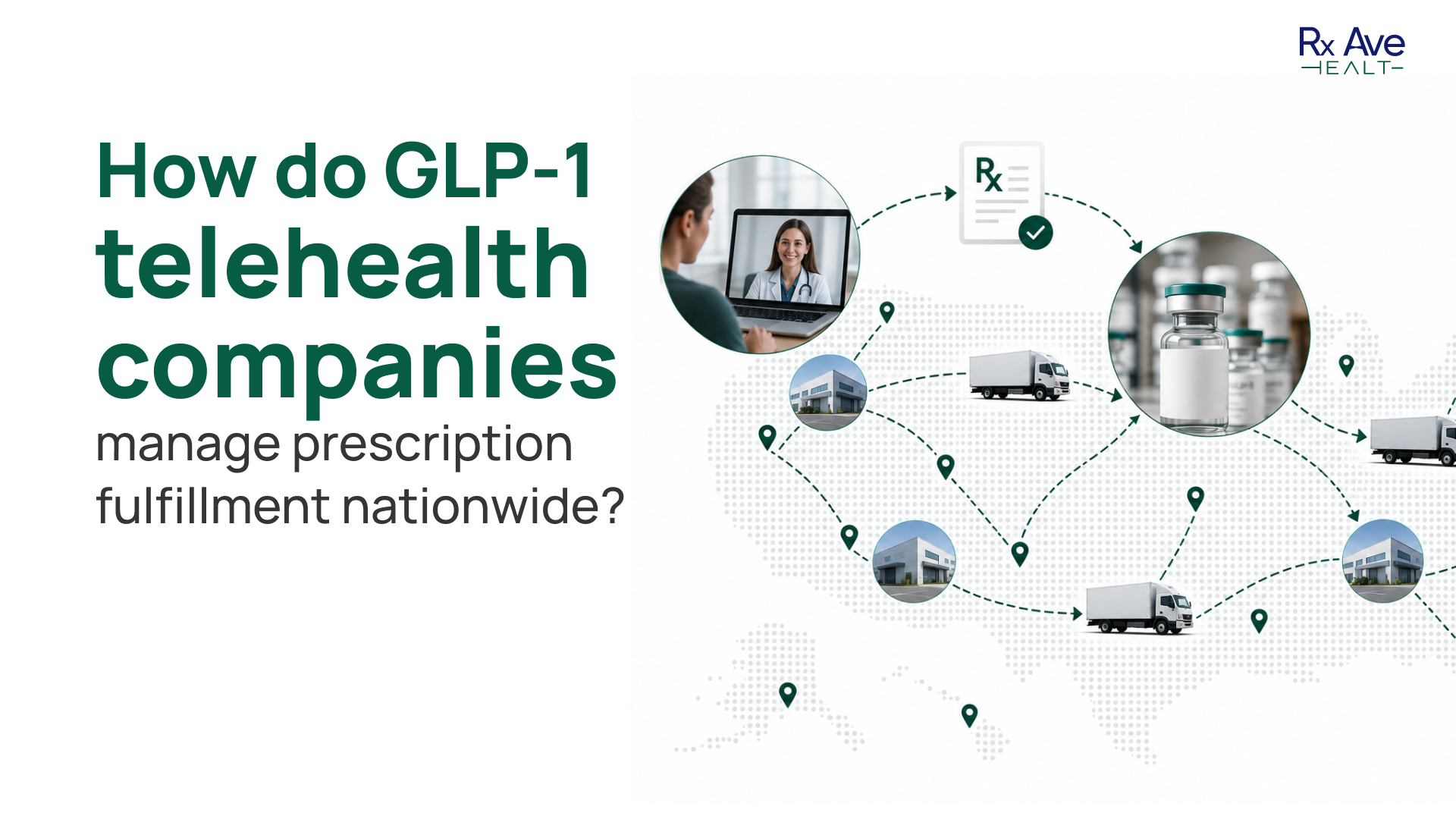
Patient consultation → Clinical decision → Prescription → Pharmacy routing → Pharmacy processing → Fulfillment → Delivery → Refill
But each step creates another opportunity for something to get stuck.
A prescription might need clarification.
A pharmacy may not be able to fulfill it.
A patient may move or be located in another state.
A refill may need a new prescription.
A shipment may be delayed.
And suddenly, the support team is spending its day answering questions like:
“Has the pharmacy received it?”
“Why hasn’t it shipped?”
“Can this pharmacy fill it?”
“What happens now?”
At low volume, someone can probably handle these manually.
At scale, that’s not a workflow. It’s a bottleneck.
How Do GLP-1 Telehealth Companies Fulfill Prescriptions Nationwide?
There isn’t one universal fulfillment model.
A telehealth company may work with retail pharmacies, mail-order pharmacies, compounding pharmacies where legally appropriate, or multiple pharmacy partners depending on its business model and the medication being prescribed.
The important part is having a system for deciding where each prescription should go and what happens after it gets there.
A nationwide model may involve:
1. Prescription routing
The prescription moves from the provider workflow to an appropriate pharmacy.
2. Pharmacy processing
The pharmacy reviews and processes the prescription according to its own requirements.
3. Fulfillment
The medication is prepared and dispensed or shipped.
4. Delivery tracking
The telehealth company and patient receive relevant shipping information where available.
5. Refill management
The process starts again when the patient needs another prescription.
6. Exception handling
If something doesn’t work, there needs to be a clear path for resolving it.
That last part gets overlooked.
A nationwide fulfillment operation isn’t defined by what happens when everything goes perfectly.
It’s defined by what happens when something doesn’t.
Why Nationwide GLP-1 Prescription Delivery Is More Complicated Than It Looks
You can’t simply put a national list of pharmacies into a spreadsheet and call it a fulfillment strategy.
Different pharmacies may have different capabilities, geographic coverage, operating processes, inventory situations, and technology.
And the clinical side has its own state-level requirements.
HHS notes that telehealth practice across state lines varies by state. Providers may need a full license, temporary practice authorization, reciprocity, participation in an interstate compact, or telehealth registration depending on the jurisdiction. HHS also advises providers to verify where the patient is located before an appointment.
So when a company says it serves patients “nationwide,” there is more behind that statement than a national marketing campaign.
The underlying workflow needs to work across the different states and pharmacy relationships involved.
The Pharmacy Network Matters
Imagine a telehealth company has patients in California, Texas, Florida, New York, and Arizona.
It may not be practical to assume that one pharmacy will be the right fulfillment option for every patient and every prescription.
This is where a telehealth GLP-1 pharmacy strategy becomes important.
The business needs to understand:
- Where can the pharmacy dispense?
- Which prescriptions can it fulfill?
- What happens when it can’t?
- How quickly are issues communicated?
- Can prescriptions be routed to another appropriate pharmacy?
- How are refills handled?
- What fulfillment information is available to the telehealth team?
The goal isn’t necessarily to build the biggest pharmacy network possible.
It’s to build a network and workflow that can keep prescriptions moving when the unexpected happens.
Technology Is the Layer Holding Everything Together
Here’s where many telehealth businesses discover a problem.
The provider submits a prescription.
Then someone on the operations team logs into another system.
Then someone checks whether the pharmacy received it.
Then someone emails the pharmacy because the status hasn’t changed.
Then support gets a patient call asking what happened.
The pharmacy itself may be doing everything correctly.
The problem is that the systems aren’t talking to each other.
That’s why integrations matter.
A scalable online GLP-1 prescription fulfillment workflow can connect:
Provider workflow → Prescription routing → Pharmacy → Fulfillment status → Patient communication
Depending on the platform, that may involve APIs, EMR or EHR integrations, prescription routing systems, pharmacy networks, order management, and status updates.
According to HHS, telehealth technology should be evaluated for reliability, fit with the practice’s needs, and integration with existing software with minimal disruption.
That same principle applies to pharmacy fulfillment.
You don’t need technology because it sounds impressive.
You need it because your team shouldn’t have to manually move the same information between five different systems.
Fulfillment Visibility Is a Bigger Deal Than It Sounds
Let’s say a patient sends a support message:
“Where is my medication?”
Your support agent checks the patient record.
Nothing useful.
They check another system.
Still nothing.
So they contact the pharmacy.
Now everyone waits.
That one question has turned into a support ticket, an internal task, a pharmacy communication, and potentially another patient follow-up.
Now imagine that happening 500 times a month.
This is why fulfillment visibility matters.
A telehealth company should ideally be able to see meaningful stages such as:
Prescription submitted → Received → Processing → Exception → Fulfilled → Shipped → Delivered
The exact information available depends on the pharmacy and technology infrastructure.
But the basic principle is simple:
Your team should know where a prescription is without having to chase someone for an answer.
Refills Are Where Fulfillment Becomes a Recurring Problem
The first prescription gets most of the attention because that’s when a patient enters the program.
But GLP-1 treatment can involve ongoing prescriptions and follow-up care.
So the real workflow isn’t:
Prescription → Delivery
It’s:
Prescription → Delivery → Refill → Delivery → Refill → Delivery
That means a pharmacy partner needs to be able to support recurring prescription volume.
The telehealth company also needs to understand:
- How refill requests are initiated
- How providers receive refill-related information
- How new prescriptions are routed
- How pharmacy exceptions are handled
- How refill status is tracked
- How patients are informed when there is a delay
A fulfillment model that works beautifully for the first 500 patients can become painful once thousands of patients are due for refills every month.
What About Compounded GLP-1s?
This is one area where telehealth companies need to be especially careful.
Compounded GLP-1s aren’t simply interchangeable with FDA-approved GLP-1 medications.
FDA states that compounded drugs are not FDA-approved and are not reviewed by the agency for safety, effectiveness, or quality before marketing. FDA also says compounded drugs should generally be used when a patient’s medical needs cannot be met by an FDA-approved drug.
The rules around compounding also matter.
In April 2026, FDA clarified that under Section 503A, compounded drugs generally must be made for an individual patient based on a prescription, and restrictions apply to regularly or inordinate amounts of drugs that are essentially copies of commercially available products.
So a telehealth company shouldn’t assume that a compounded GLP-1 can simply be sourced and shipped nationwide because a pharmacy offers it.
The specific medication, formulation, pharmacy, compounding pathway, patient need, and applicable requirements all matter.
There is also a marketing issue.
In March 2026, FDA announced warning letters to 30 telehealth companies over misleading claims about compounded GLP-1 products. The agency specifically flagged claims implying compounded products were the same as FDA-approved drugs and claims that obscured who actually compounded the medication.
FDA’s current guidance also warns telehealth companies against describing compounded medications as FDA-approved, as generic versions of FDA-approved drugs, or as being produced by an “FDA-approved” or “FDA-licensed” pharmacy.
So fulfillment and marketing need to tell the same story.
Can Every Pharmacy Fill a Telehealth GLP-1 Prescription?
No.
A prescription doesn’t automatically become fillable at any pharmacy simply because it was written by a telehealth provider.
The pharmacy needs to be appropriately licensed and able to dispense the medication under the applicable requirements.
FDA recommends that consumers use state-licensed online pharmacies and provides state pharmacy-board databases for checking pharmacy licenses.
For a telehealth company, pharmacy verification should therefore happen before a pharmacy becomes part of the fulfillment network, not after a prescription gets rejected.
And if compounded medications are involved, there are additional questions around the compounder and the applicable compounding framework.
For example, FDA maintains a current list of registered 503B outsourcing facilities and provides registration and inspection information. The current list was updated September 8, 2026.
What Happens When a Prescription Gets Rejected?
This is where a real fulfillment infrastructure earns its keep.
A prescription can fail for several reasons.
The pharmacy may need additional information.
The prescription may not be appropriate for that pharmacy’s workflow.
The pharmacy may not be able to fulfill it.
There may be a coverage or location issue.
Whatever the reason, your team needs to know:
What happened?
Who needs to act?
What happens next?
A good workflow turns that into a defined exception process rather than an endless email chain.
For example:
Prescription rejected → Reason identified → Provider/operations notified → Appropriate resolution → Prescription rerouted or corrected → Status updated
The exact workflow will depend on the business and pharmacy relationships.
The principle doesn’t change.
Exceptions should be managed as part of the system, not treated like surprises every time they happen.
How Long Does GLP-1 Prescription Fulfillment Take?
There isn’t one nationwide answer.
Fulfillment time can depend on:
- Whether the prescription is complete
- Pharmacy processing time
- Medication availability
- Whether additional information is required
- The pharmacy’s fulfillment model
- Shipping method
- Patient location
- Whether the prescription involves a compounded medication
That makes it risky for telehealth companies to promise one universal delivery timeline.
A better approach is to provide accurate status information.
If the prescription is processing, the patient should know.
If there is an exception, the team should know.
If the medication has shipped, the relevant tracking information should be available where supported.
Predictability is often more valuable than an aggressive delivery promise.
A Nationwide GLP-1 Fulfillment Checklist
Before scaling a GLP-1 program, telehealth operators should be able to answer:
Pharmacy network
☐ Which pharmacies can serve our patient population?
☐ Where is each pharmacy licensed?
☐ What happens when a pharmacy cannot fulfill a prescription?
☐ Do we have an appropriate backup or routing strategy?
Prescription workflow
☐ How are prescriptions routed?
☐ How are rejected prescriptions handled?
☐ How are refills managed?
☐ How are pharmacy exceptions escalated?
Technology
☐ Do our systems integrate with pharmacy workflows?
☐ Can we access meaningful fulfillment status?
☐ Are APIs or other integrations available?
☐ How much manual work is required?
Compliance
☐ Are provider and patient locations being handled appropriately?
☐ Are state-specific telehealth requirements being considered?
☐ If compounded GLP-1s are involved, is the applicable compounding pathway clear?
☐ Are all marketing claims about compounded medications accurate?
☐ Is the pharmacy appropriately licensed or registered for the services it provides?
If the answer to several of these is “we’re not sure,” the fulfillment model probably needs more work before prescription volume increases.
The Real Challenge Isn’t Getting One GLP-1 Prescription Filled
It’s getting thousands of them filled without turning your operations team into a giant pharmacy follow-up department.
That requires more than a pharmacy relationship.
It requires connected prescription routing, pharmacy coordination, refill management, fulfillment visibility, exception handling, and the ability to support different pharmacy relationships as the business grows.
That’s the infrastructure layer many telehealth companies don’t think about until they need it.
RxAve helps telehealth companies connect prescription routing, pharmacy coordination, refill management, fulfillment workflows, and operational visibility through one connected infrastructure layer.
Because nationwide GLP-1 telehealth prescription fulfillment shouldn’t depend on someone remembering to check an inbox.
It should be a workflow that works.
Ready to Streamline Your GLP-1 Prescription Fulfillment?
RxAve helps telehealth companies simplify prescription routing, pharmacy coordination, refill management, and fulfillment workflows through one connected infrastructure layer.
Build a more reliable, scalable workflow for nationwide GLP-1 telehealth prescription fulfillment.
FAQs
How do GLP-1 telehealth companies fulfill prescriptions nationwide?
They typically connect their clinical workflow with one or more appropriate pharmacy or fulfillment partners. The prescription is routed to the pharmacy, processed, fulfilled, and delivered, with additional workflows for status updates, exceptions, and refills. The exact model depends on the medication, pharmacy network, patient location, and applicable federal and state requirements.
Can a GLP-1 prescription from a telehealth provider be filled at any pharmacy?
Not necessarily. The pharmacy must be appropriately licensed and able to dispense the medication under the applicable requirements. State rules and the specific medication can also affect where a prescription can be filled. FDA recommends using state-licensed pharmacies and provides resources for verifying online pharmacy licenses.
Do GLP-1 telehealth companies use compounding pharmacies?
Some telehealth companies may work with compounding pharmacies where legally appropriate, but compounded GLP-1s have specific requirements and are not FDA-approved. FDA says compounded drugs should generally be used when a patient’s medical needs cannot be met by an FDA-approved drug.
How do telehealth companies handle GLP-1 prescriptions across state lines?
The clinical side has to account for where the patient is located and whether the provider is authorized to practice there. HHS explains that state requirements vary and can involve full licensure, temporary practice rules, reciprocity, interstate compacts, or telehealth registration.
How long does GLP-1 prescription fulfillment take?
There isn’t a universal timeline. It depends on the pharmacy, prescription, medication availability, processing requirements, shipping method, patient location, and other factors. A telehealth company should avoid promising a fixed nationwide timeline unless its fulfillment network can consistently support it. Accurate prescription and shipping status updates are often more useful.