Table of Contents
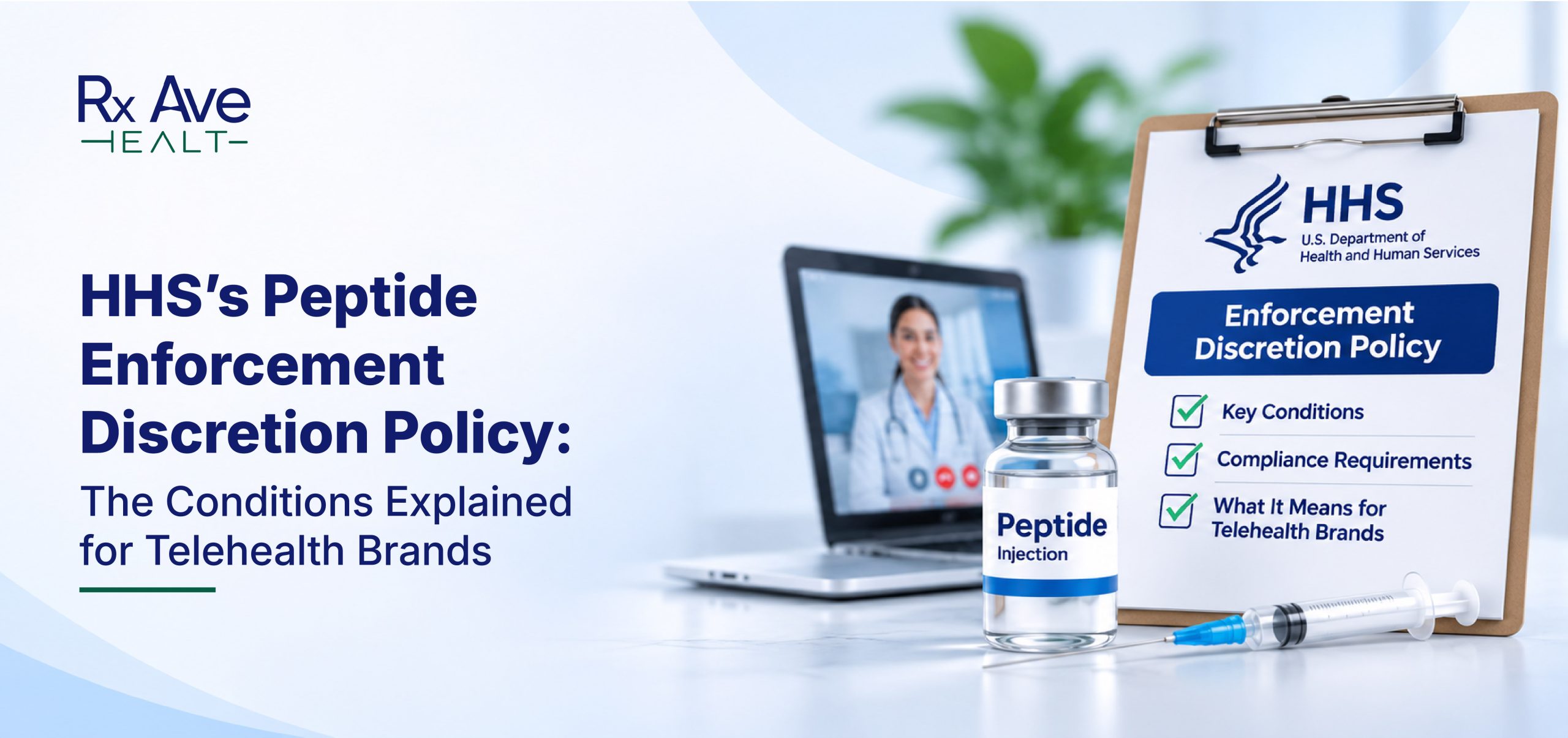
Quick answer: On October 28, 2026, HHS issued an interim policy saying it does not intend to take enforcement action against state-licensed pharmacies, federal facilities, or licensed physicians that compound with six peptides, as long as ten conditions are met. It is not an FDA approval, it is not permanent, and state law still applies. For 503A peptide compounding, the details decide who can launch safely.
What the policy does, and what it doesn’t
HHS’s enforcement discretion policy addresses 503A peptide compounding with six bulk substances that don’t otherwise qualify under section 503A. Foley & Lardner explains that none of the six meets the usual routes to eligibility: a USP monograph, status as a component of an FDA-approved drug, or a place on FDA’s bulks list.
What the policy does: it gives covered compounders a conditional path to prepare these products without federal enforcement action, while FDA works through its rulemaking.
What it doesn’t do: it does not add the peptides to the 503A bulks list, and it does not approve any compounded product. HHS has also said it may revisit the policy if safety or quality problems appear. Written comments are open through November 13, 2026, according to Foley.
The six peptides covered
The policy covers BPC-157, TB-500, KPV, MOTS-c, Epitalon, and Semax. These are six of the seven peptides FDA’s Pharmacy Compounding Advisory Committee reviewed in July. Emideltide, the seventh, is not covered.
The 10 conditions, and who typically owns each
HHS’s protection applies only when all conditions are met. The table below summarizes them in plain language, based on Foley’s summary. The “typical owner” column is our suggestion, not part of the policy. Ownership varies by arrangement, so confirm it in your contracts.
| # | Condition | Typical owner | Proof to keep |
| 1 | The peptide is one of the six listed in the policy’s appendix | Prescriber and platform | Formulary limited to the six |
| 2 | Identity and route of administration match the appendix | Prescriber and pharmacy | Order matches appendix limits |
| 3 | Bulk substance comes from an FDA-registered facility, with a valid certificate of analysis (COA) | Pharmacy | COA on file for each lot |
| 4 | The original manufacturer is registered and meets CGMP | Pharmacy | Supplier qualification file |
| 5 | Serious adverse events are reported to FDA’s MedWatch | Pharmacy, with prescriber and platform support | Written reporting procedure and log |
| 6 | Label reads: “This is a compounded drug product. Not for resale.” | Pharmacy | Label proof |
| 7 | The product has a single active ingredient | Prescriber and pharmacy | Order setup that blocks blends |
| 8 | Oral products: documentation that the formulation is adequately bioavailable in humans | Pharmacy | Formulation documentation |
| 9 | The only co-packaged device is an FDA 510(k)-cleared syringe | Pharmacy | Packaging specification |
| 10 | Everything else follows the FD&C Act | Pharmacy | Pharmacy compliance file |
Most law-firm summaries list these conditions. Few show who actually does the work. That gap is where telehealth brands get into trouble: everyone assumes someone else owns the COA, the label check, or the MedWatch report.
Who is covered, and where telehealth brands fit
As summarized by Foley and the American Med Spa Association, the policy names state-licensed pharmacies, federal facilities, and licensed physicians. It does not name marketing-only brands or platforms.
That doesn’t mean telehealth brands are shut out. It means your program has to be built so that the covered parties, the pharmacy and the prescriber, do the regulated work, and your brand doesn’t blur those roles. Ask counsel how the policy applies to your specific structure.
Why Prescription Fulfillment Infrastructure decides who can execute
A policy is only useful if the operations behind it can meet its conditions. This is where Prescription Fulfillment Infrastructure matters: the routing, documentation, tracking, and pharmacy relationships that sit between a prescriber’s order and a patient’s delivery.
Three things separate brands that can launch from brands that stall:
- A pharmacy fulfillment network. One pharmacy is one point of failure. A pharmacy fulfillment network lets you route by state and medication, and gives you a backup if a pharmacy can’t ship.
- A turnkey setup. A turnkey pharmacy fulfillment solution means pharmacies are already vetted and integrated, so you aren’t negotiating contracts, building separate integrations, and checking compliance one pharmacy at a time.
- Tracking you don’t have to chase. Order status should flow back to your platform automatically.
RxAve Health is built for this layer: one integration connecting telehealth brands, med spas, and provider groups to integrated 503A pharmacies, with prescription routing, payment coordination, and order tracking.
503A peptide compounding: how to verify sourcing and COAs
The policy’s sourcing conditions are where most of the real work sits. A practical check looks like this:
- Ask your pharmacy which FDA-registered facility supplies each bulk peptide.
- Request the COA for the lot being used, and confirm it documents identity and quality.
- Confirm the pharmacy qualifies its suppliers for CGMP compliance.
- Treat research-use-only (RUO) products as out of scope. The policy was framed partly to steer the market away from RUO peptides supplied by foreign manufacturers, according to Foley.
If a pharmacy can’t show you this paperwork quickly, that is useful information.
The state-board layer
Federal enforcement discretion is not state permission. Prescribers and med spas must still follow state prescribing, compounding, scope-of-practice, and pharmacy rules, as the American Med Spa Association notes.
States are already active. Ohio’s Board of Pharmacy has issued peptide guidance for med spas and has revoked or suspended several med spas’ licenses over peptide violations, according to Brennan Manna Diamond’s summary.
Build a state-by-state checklist for every state you ship to: what the board has said, whether guidance exists, and whether your pharmacy is licensed there. Verify each item with the board directly.
How to market peptide programs compliantly
FDA has spent the past year sending warning letters to telehealth companies over compounded GLP-1 marketing. In March 2026 it sent 30 letters, many alleging that ads implied sameness with FDA-approved drugs. The same logic is a sensible guide for peptides, though you should confirm it with counsel.
Safer habits:
- Never say “approved,” “FDA-cleared,” or “legal in all 50 states.”
- Describe products as compounded, prescribed by a licensed provider, and dispensed by a pharmacy.
- Don’t imply your brand is the compounder when it isn’t.
- Avoid “same as” or “generic” language.
A peptide telehealth compliance checklist
Use this peptide telehealth compliance checklist before you launch, and revisit it whenever the policy changes:
- Your pharmacy confirms in writing how it meets each of the ten conditions.
- COAs and supplier registration proof are on file for each lot.
- Orders are limited to the six peptides, single-ingredient, and appendix-approved routes.
- Labels carry the required compounded-drug statement.
- Someone is named as owner of MedWatch adverse event reporting.
- Every prescription is patient-specific and follows a documented clinical evaluation.
- Informed consent states that the product is compounded and not FDA-approved, per inhouse.ai’s guidance.
- State board rules are checked for every state you ship to.
- Marketing copy is reviewed for “approved” and “same as” claims.
- No RUO sources are used anywhere in the supply chain.
- A contingency plan exists if the policy changes.
- Counsel has reviewed the program.
Building a peptide program for med spas with a 503A pharmacy
A peptide program for med spas 503A pharmacy partnership starts with roles. A med spa sits at the intersection of state medical practice law, FDA compounding rules, and corporate practice of medicine rules, according to inhouse.ai. Med spas also can’t buy peptides from unregulated or research-use-only sellers and administer them to patients.
In practice, a med spa should confirm its licensed prescriber, choose a 503A pharmacy that can document the ten conditions, and make sure every patient has a patient-specific prescription. A pharmacy fulfillment network is useful here because it lets a med spa add peptides without another vendor, login, and contract.
What to check before launching white label peptide telehealth
White label peptide telehealth adds one extra risk: whose name is on the product. FDA’s updated guidance on compounded GLP-1 marketing flags branding that implies the telehealth company is the compounder. The same caution is sensible for peptides.
Before launching, ask:
- Who is the dispensing pharmacy, and is that clear to patients?
- Does the label and website accurately show who compounds the product?
- Which party is the prescriber, and how is patient-specific prescribing documented?
- Can the platform support white-label branding without hiding who does the regulated work?
What if HHS revisits the policy?
The policy can change. HHS may revisit it if safety signals or quality problems appear, and FDA’s rulemaking could eventually propose adding some or all of these peptides to the bulks list, according to Foley.
Plan for three scenarios: the policy stays, it is narrowed or withdrawn, or the peptides move to a formal rule. In each, the brands that adapt fastest are the ones with a flexible formulary and more than one integrated pharmacy to route through.
Planning a peptide program? Get in touch.
If you’re a telehealth brand, med spa, or provider group building a peptide program, RxAve Health can help you connect to integrated 503A pharmacies through one integration, with routing and order tracking built in. Get in touch with the RxAve team to talk through your launch.
Frequently asked questions
1. What does the HHS peptide enforcement discretion policy do?
It says HHS does not intend to take enforcement action against covered compounders using six specified peptides, provided all listed conditions are met. It is a temporary, conditional policy, not a rule.
2. Which six peptides are covered?
BPC-157, TB-500, KPV, MOTS-c, Epitalon, and Semax.
3. Is it FDA approval?
No. The policy does not add these substances to the 503A bulks list or constitute FDA approval.
4. Who is covered?
State-licensed pharmacies, federal facilities, and licensed physicians when all conditions are met.
5. Does it override state law?
No. Prescribers and medical spas must still comply with applicable federal and state prescribing, compounding, scope-of-practice, and pharmacy requirements.
6. Can HHS change it?
Yes. HHS “may revisit” the policy if a safety signal or product quality issue emerges.