
Table of Contents
A pharmacy may have room to operate under a federal enforcement discretion policy and still face restrictions when dispensing or shipping a medication into another state.
That distinction matters for telehealth companies, digital health brands, and pharmacy partners building nationwide prescription services. Federal policies do not automatically replace state pharmacy laws. A pharmacy’s ability to compound a medication, dispense it, and ship it to a patient can depend on several separate requirements.
For businesses planning pharmacy shipping across state lines, the question is not simply whether federal regulators are currently exercising enforcement discretion. It is whether the pharmacy, prescriber, prescription, and medication meet the applicable requirements in the states involved.
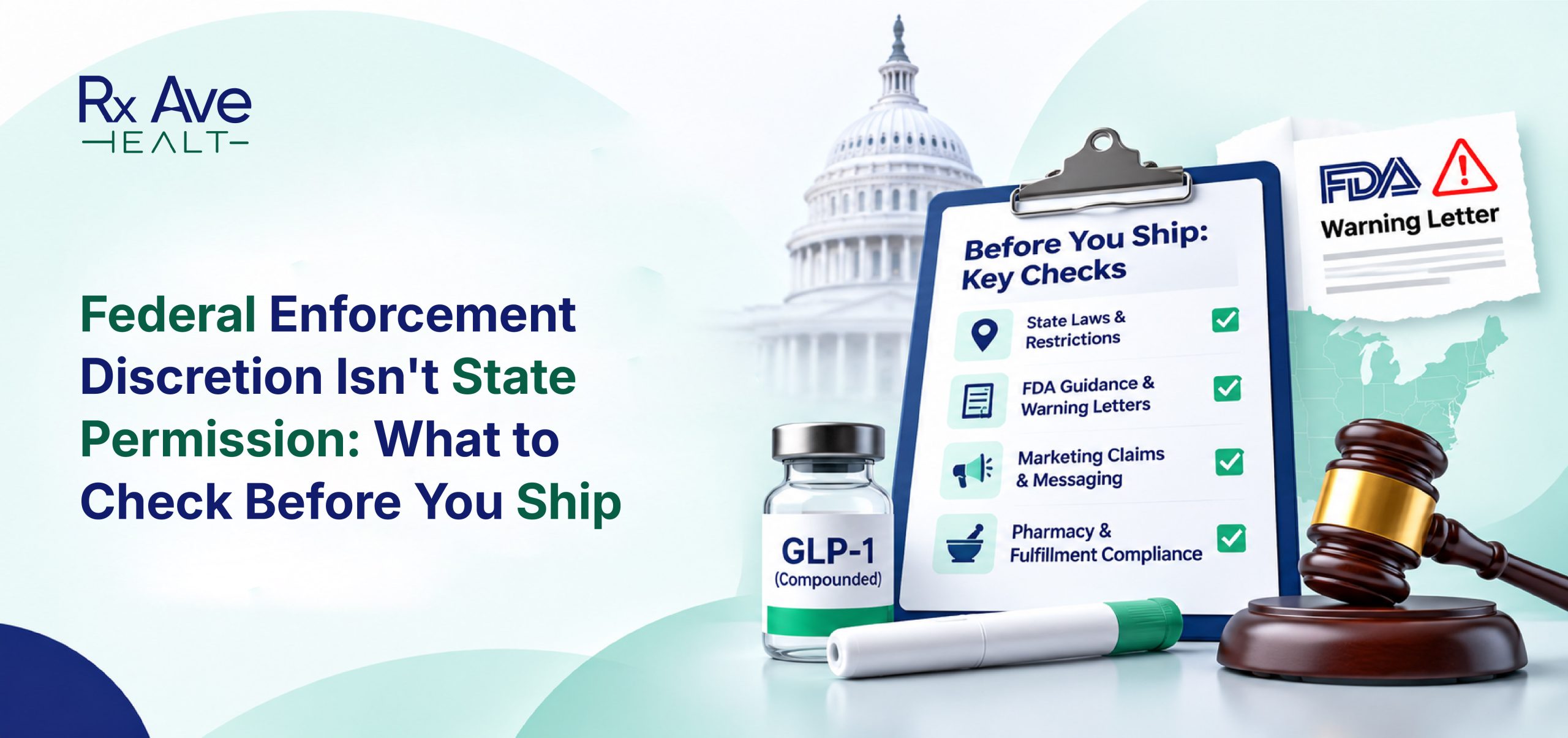
Before expanding nationwide prescription fulfillment, here are the checks that deserve attention.
What Federal Enforcement Discretion Actually Means
Federal enforcement discretion generally describes circumstances in which a federal agency, such as the FDA, indicates that it does not intend to pursue certain enforcement actions under specified conditions.
It is not the same as an approval, license, or blanket authorization.
For example, FDA policies concerning drug compounding may address how the agency intends to exercise its federal enforcement authority in particular situations. Those policies do not automatically grant a pharmacy permission to operate in every state or override requirements established by state pharmacy boards.
This distinction is especially important for compounded medications.
Under sections 503A and 503B of the Federal Food, Drug, and Cosmetic Act, certain conditions allow qualifying compounding activities to receive exemptions from specific federal requirements. These exemptions are not interchangeable, and they do not eliminate all other federal or state obligations.
The takeaway: Federal enforcement discretion should never be treated as a substitute for state-level authorization.
503A Pharmacy State Licensing: Why It Matters Before Shipping
A pharmacy’s home-state license does not automatically establish that it can dispense prescriptions to patients throughout the country.
When a pharmacy serves patients outside its home state, it may need to satisfy additional requirements in the destination state. Depending on the jurisdiction and the pharmacy’s activities, these may include nonresident pharmacy licensure, registration, or other state-specific approvals.
This is where 503A pharmacy state licensing becomes a critical part of the operational review.
A 503A pharmacy generally compounds medication for an identified individual patient based on a valid prescription, subject to applicable federal conditions and state law. Its ability to serve patients across state lines must be assessed separately from its federal compounding status.
Before shipping, verify:
- Home-state licensing: Is the pharmacy currently licensed and in good standing in the state where it operates?
- Destination-state authorization: Does it hold the required nonresident pharmacy license, registration, or other authorization for the patient’s state?
- Compounding requirements: Does its compounding activity meet applicable federal and state conditions?
- Prescription validity: Is the prescription issued by an appropriately authorized prescriber and supported by the required patient-specific documentation?
- State restrictions: Are there additional restrictions on the medication, dosage form, compounding activity, or dispensing process?
Requirements can differ by state. A license in one jurisdiction should not be assumed to cover every destination.
503A vs. 503B: The Distinction Telehealth Brands Should Understand
Not every compounding pharmacy operates under the same federal pathway. Understanding the difference between 503A pharmacies and 503B outsourcing facilities is important when evaluating a pharmacy partner.
503A pharmacies
503A pharmacies generally compound medication for individual patients based on valid prescriptions. Their activities are subject to the conditions in Section 503A, along with applicable state pharmacy laws and board requirements.
For telehealth businesses, this means the prescription workflow, patient-specific documentation, prescriber authority, and destination-state requirements all need to be considered.
503B outsourcing facilities
503B outsourcing facilities are facilities registered with the FDA that may compound certain drug products under the conditions of Section 503B. They are subject to additional federal requirements, including applicable current good manufacturing practice requirements and FDA inspection authority.
Registration as a 503B outsourcing facility does not automatically resolve every state-level licensing, registration, or distribution requirement.
The appropriate regulatory pathway depends on the facility’s activities, the product involved, and applicable federal and state requirements. A business should not assume that a 503B registration or a 503A pharmacy license provides universal shipping authority.
7 Checks to Complete Before Pharmacy Shipping Across State Lines
A nationwide service model requires more than a pharmacy that can process and ship prescriptions. It requires a documented process for confirming that each part of the transaction is authorized.
Use these checks before activating a new state.
1. Confirm the pharmacy’s license in the destination state
Verify whether the pharmacy is authorized to serve patients in each state where it intends to dispense or ship medication.
For pharmacy shipping across state lines, check the relevant state board of pharmacy’s licensing database. Confirm the license type, current status, expiration date, and any restrictions.
Do not rely solely on a pharmacy’s statement that it ships nationwide.
2. Verify the pharmacy’s compounding category
Determine whether the pharmacy operates under Section 503A or is an FDA-registered 503B outsourcing facility.
The distinction affects the applicable federal conditions and operational responsibilities. Confirm that the pharmacy’s actual activities align with the regulatory pathway it claims to follow.
3. Check prescriber authority in the patient’s state
The pharmacy’s license is only one part of the prescription process.
The prescriber must also be appropriately authorized to practice and prescribe in the state where the patient is located, subject to applicable exceptions and state rules.
Telehealth businesses should verify provider credentials, state licensing, prescribing authority, and any medication-specific requirements before a prescription is transmitted.
4. Review the medication and compounding requirements
A medication’s regulatory status can affect whether and how it may be compounded.
Review the applicable federal conditions, including relevant restrictions involving bulk drug substances, drug products that are essentially copies of commercially available products, and other limitations under Sections 503A or 503B.
Also review state-specific compounding and dispensing rules.
A federal enforcement discretion policy should not be interpreted as a blanket authorization to compound or distribute every medication.
5. Confirm shipping and dispensing requirements
Before implementing nationwide prescription fulfillment, establish whether the pharmacy can legally dispense and ship the specific medication to the intended destination.
Depending on the product and state, additional considerations may include:
- Prescription documentation and retention.
- Patient counselling requirements.
- Packaging and temperature-control requirements.
- Controlled-substance restrictions, where applicable.
- Delivery procedures and shipping records.
- State-specific restrictions on dispensing or delivery.
The shipping process should be reviewed alongside the dispensing process, not treated as a separate administrative step.
6. Document the compliance process
A pharmacy or telehealth business should maintain records showing how it determines where it can serve patients.
A state-by-state compliance matrix can help track:
- Pharmacy license and renewal status.
- Nonresident licensing or registration requirements.
- Prescriber authorization.
- Applicable compounding pathway.
- Medication-specific restrictions.
- Shipping and dispensing requirements.
- Review dates and responsible personnel.
This information should be reviewed regularly because licensing status, regulations, and agency policies can change.
7. Establish a process for regulatory changes
A state that permits a particular activity today may update its requirements later. Federal guidance may also change.
Assign responsibility for monitoring FDA announcements, state board updates, and relevant licensing changes. Build a process to pause or restrict fulfillment when a required authorization expires, a rule changes, or a compliance concern arises.
A reliable system should be able to identify affected states and stop orders from being processed until the issue is resolved.
What Telehealth Brands Should Ask a Pharmacy Partner
For a telehealth company, pharmacy selection is an operational and regulatory decision not simply a pricing or delivery decision.
A pharmacy partner should be able to explain its licensing coverage, compounding model, dispensing procedures, and ability to support the states in which the business operates.
Before signing an agreement, ask:
- Which states are you currently licensed or otherwise authorized to serve?
- Can you provide verification of applicable nonresident pharmacy licenses?
- Do you operate as a 503A pharmacy or an FDA-registered 503B outsourcing facility?
- How do you verify prescriptions and prescriber authorization?
- How do you monitor state-specific compounding and dispensing requirements?
- What happens when a license expires or a state changes its rules?
- Can you provide documentation of your shipping, fulfillment, and quality-control procedures?
A partner should provide clear answers and supporting documentation. Statements such as “we ship to all 50 states” are not a substitute for verifying the legal basis for that activity.
How a White Label Telehealth Platform Fits Into the Process
A white label telehealth platform can help healthcare businesses coordinate patient intake, provider workflows, prescription management, and pharmacy fulfillment under their own brand.
However, technology does not create pharmacy authorization.
A platform may support state-based workflows, maintain provider records, route prescriptions, and coordinate with pharmacy partners. The underlying pharmacy and prescriber must still meet the requirements applicable to their respective activities.
Before launching in a new state, telehealth brands should confirm:
- The pharmacy is authorized to serve patients in that destination state.
- The prescriber has the required state authority.
- The medication and compounding activity meet applicable requirements.
- The platform’s prescription and fulfilment workflows support the required documentation.
- Responsibilities between the platform, provider, and pharmacy are clearly defined.
The goal is to build a model in which technology supports compliant operations rather than assuming that a nationwide platform automatically enables nationwide dispensing.
Nationwide Fulfilment Starts With State-by-State Verification
Federal enforcement discretion can influence how the FDA approaches specific enforcement situations. It does not grant universal permission to compound, dispense, or ship medications across state lines.
For pharmacies and telehealth businesses, the practical responsibility is to verify each part of the process: pharmacy authorization, prescriber authority, medication requirements, dispensing procedures, and destination-state rules.
A documented state-by-state review is more reliable than relying on broad claims about nationwide availability.
RxAve helps healthcare businesses evaluate pharmacy fulfillment needs and build pharmacy partnerships around their operational requirements. Before expanding into new states, make sure your pharmacy partner can clearly explain its licensing coverage, dispensing model, and fulfilment procedures.
Connect with RxAve to discuss pharmacy fulfillment and your nationwide service requirements.
Frequently Asked Questions
1. Can a 503A pharmacy ship compounded medications across state lines?
A 503A pharmacy may be able to dispense and ship compounded medications to patients in other states, but it must meet applicable federal compounding conditions and destination-state requirements. These may include nonresident pharmacy licensing or registration, depending on the state and activity.
2. Does FDA enforcement discretion override state pharmacy laws?
No. FDA enforcement discretion concerns the agency’s exercise of federal enforcement authority. It does not automatically override state pharmacy laws, licensing requirements, or restrictions imposed by state boards of pharmacy.
3. Does a 503A pharmacy need a nonresident license in every state?
Not necessarily under identical rules. Requirements vary by jurisdiction and may depend on the pharmacy’s activities and the applicable state laws. Pharmacies should verify each destination state’s licensing and registration requirements before dispensing or shipping.
4. What should telehealth companies verify before nationwide prescription fulfillment?
They should verify pharmacy licensing, prescriber authorization, medication-specific requirements, applicable compounding rules, prescription documentation, and state-specific dispensing and shipping restrictions. These checks should be documented and reviewed regularly.
5. Can a white label telehealth platform authorize pharmacy shipping across state lines?
No. A white label telehealth platform can support prescription workflows and pharmacy coordination, but it does not grant pharmacy or prescriber licenses. The pharmacy and prescriber must independently meet the requirements applicable to their services.